
Environmental Sustainability
We attach great importance to sustainability and environmental responsibility, and we are committed to reducing our impact on the environment.
The use of animal-derived raw materials is particularly resource-efficient and sustainable. The animal organs used come from three different sources:
- PRIMACYT holds a licence to use animal by-products for diagnostic or research purposes in accordance with the Animal By-products Disposal Act. This licence enables the company to process organs from farm animals – which, as slaughter by-products, are not used in food production – into biological test systems and to use them for testing chemicals.
- Since 2005, PRIMACYT has held a licence to keep and breed laboratory animals in accordance with Section 11 of the Animal Welfare Act. PRIMACYT also holds a licence to carry out experiments on live vertebrates in accordance with Section 8a (1, 3b) (removal of organs or tissues for scientific or diagnostic purposes) of the Animal Welfare Act.
- PRIMACYT collaborates with AAALAC (Association for Assessment and Accreditation of Laboratory Care)-certified facilities in the European Union and obtains surplus tissue from control animals used in animal experiments from these companies. We process this tissue, which would otherwise be destroyed, into sustainable biological test systems. These test systems are resource-efficient, in line with the 3R principle (reduce, refine, replace), and cost-effective, but cannot completely replace animal testing.
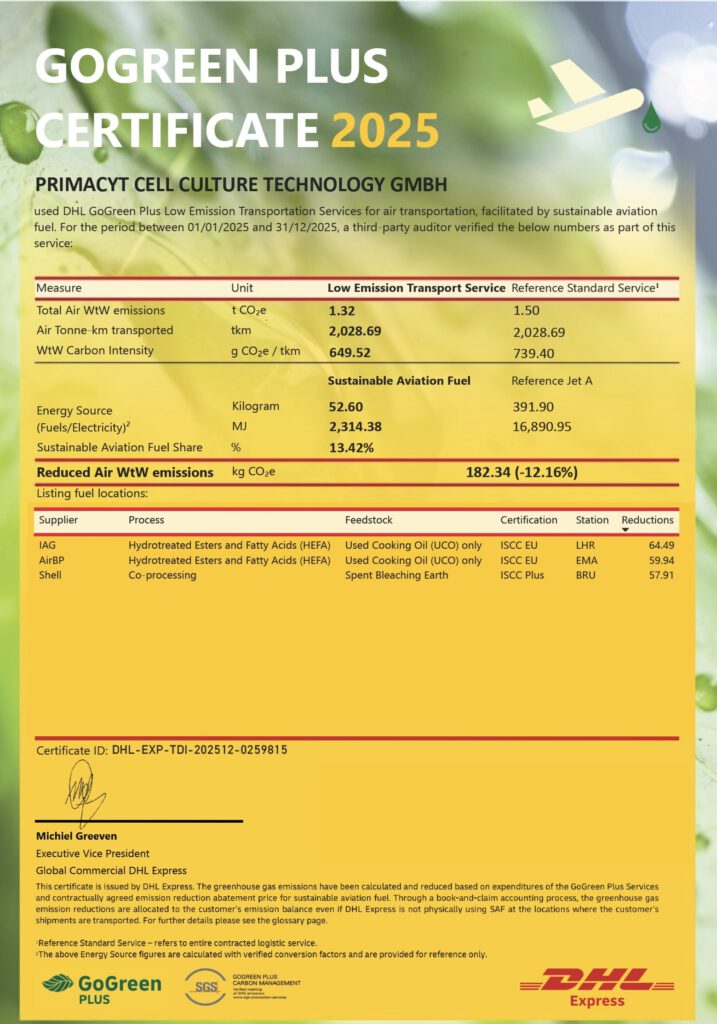
PRIMACYT is engaged in low emission transport solutions. In 2025, we have used DHL GoGreen Plus Low Emission Transportation Services for air transportation, facilitated by sustainable aviation fuel. By doing so, Well-to -Wheel emissions were reduced by more than 12% in 2025.
Starting September 1, 2026, this will be extended to land transportation by using the DHL GOGreen Plus Economy Select service. Under this scheme, the CO₂ emissions from European road transport are reduced through the use of HVO (hydrotreated vegetable oil). HVO is a synthetic diesel fuel produced from biological residues and waste materials and results in significantly lower greenhouse gas emissions than fossil diesel fuel. It is important to note that the emissions are not offset retrospectively, but are reduced directly within the transport chain. This direct emission reduction aims to achieve a CO₂ reduction of approximately 70 per cent compared with standard diesel fuel.
For more Information
or Support
We will answer your questions and reply as soon as we can.